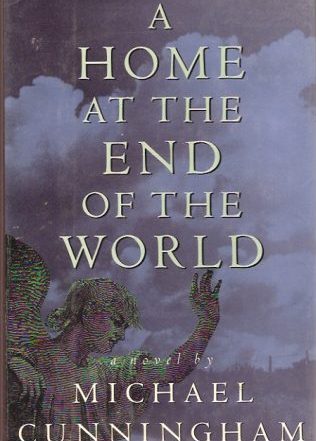
Annotation
“Home at the End of the World” is Michael Cunningham’s first book. In the brief preface to the New York edition, Cunningham writes that he worked on it for six years and under not very comfortable conditions. Everything “from a working typewriter to a roof over our heads” was a problem, he says, especially in the beginning. In 1990, when the book was published, its author was thirty-seven.
The novel begins in the mid-1960s, an era of “foolish optimism,” as Cunningham himself defines those years in an interview with the English magazine Independent (March 1991), and ends on the cusp of the 1990s, in a very different historical air. All the signs and plaques among which – despite the troubles and turmoil – we had somehow settled in, suddenly faded and flew off at once. The old explanations no longer explain anything. At least, that’s how it seems to Cunningham. The man in the space of his novel is once again alone with the vast, incomprehensible and unpredictable world – defenseless and a little ridiculous (“galaxies explode over his head, and he is in just his polka-dot underpants”), just as ill-prepared for death as for life. The characters in “Home at the End of the World” are not sure of anything, even when – occasionally – they do decisive things. “Sweetheart,” one of the main characters says to her daughter, “someday you’ll say thank you to me…” and then adds: – Or maybe not.” This lack of certainty sets a peculiarly pulsating rhythm throughout the book. Cunningham–and this, I think, is one of the secrets of his artistic charm–is ashamed to claim to know something, much more ashamed than to admit ignorance. This is akin to the author’s characters, who also take the time to share their most important insights with each other. Open to the reader, these grains of “unquestionable” – at least for themselves – knowledge usually do not extend beyond their internal monologues.
Answering the imminent question about the novel’s autobiographical nature, dealing with such painful topics as intra-family and intergenerational relationships, same-sex love, drugs, AIDS, aging and loneliness, Cunningham, in the interview already cited, cautions against direct transference and identification. “I am not one of my heroes,” he declares. And he continues, “I’ve noticed that if I start writing too autobiographically, it turns out either too sentimental or too evil.
“House at the End of the World” is a very intimate and, for all its frankness, a very chaste book. As in any profound book, the main object of the plot and the main spring of the story, the Mystery only shines through the masterfully developed “domestic” fabric, never coming to the forefront, where deliberateness and distortion are inevitable. This restraint allows Cunningham to free the book completely from moralizing, preserving its “through” poetics and complex-mirror composition. It is not without reason that the novel concludes with an episode on the lake, which transparently rhymes with the “water” scene from Part I.
Cost: 75$